A no-knead routine that asks almost nothing of you — and pays back all week.
The Method That Finally Stuck
Most bread-making advice undersells the waiting and oversells the work. The truth is the opposite: a good loaf needs almost no effort and a lot of time, and once you accept that, baking bread becomes less of a weekend project and more of a background hum to your week.
The no-knead method — developed and popularised in the early 2000s and made famous in a 2006 New York Times piece by Mark Bittman — works because a long, slow rise does what kneading does manually: it develops gluten. You stir a shaggy dough together on Thursday evening, and by Friday lunchtime you have something worth baking. The only flair required is tipping it into a hot pot.
Mark Bittman
Food writer
American food writer whose 2006 New York Times piece brought the no-knead method out of the bakery and into home kitchens everywhere.
Referenced here for the origin of the method.
Here's the version we make most weeks:
You’ll need
- 400 g strong white bread flour, plus more for shaping
- 1 g (¼ tsp) instant yeast
- 8 g (1½ tsp) fine salt
- 300 ml cool water
The method
- The night before: combine flour, yeast and salt in a large bowl. Add the water and mix with a spoon or your hand until a rough, sticky dough forms — no dry patches, no smoothness required. Cover with a plate or damp cloth and leave at room temperature.
- After 12–18 hours the dough should be bubbly and have roughly doubled. Turn it out onto a lightly floured surface. Fold it over itself two or three times, then shape loosely into a ball. Place it seam-side up in a floured bowl lined with a cloth, or on a square of floured baking paper. Leave to rest for 1–2 hours while you heat the oven.
- Place a lidded cast-iron pot (or any heavy ovenproof pot with a lid) in the oven and heat to 240 °C / 220 °C fan for at least 30 minutes.
- Tip the dough — seam-side down now — into the hot pot. Score the top once with a sharp knife or scissors. Lid on; bake 30 minutes. Remove the lid; bake a further 15 minutes until the crust is deep brown and the base sounds hollow when tapped.
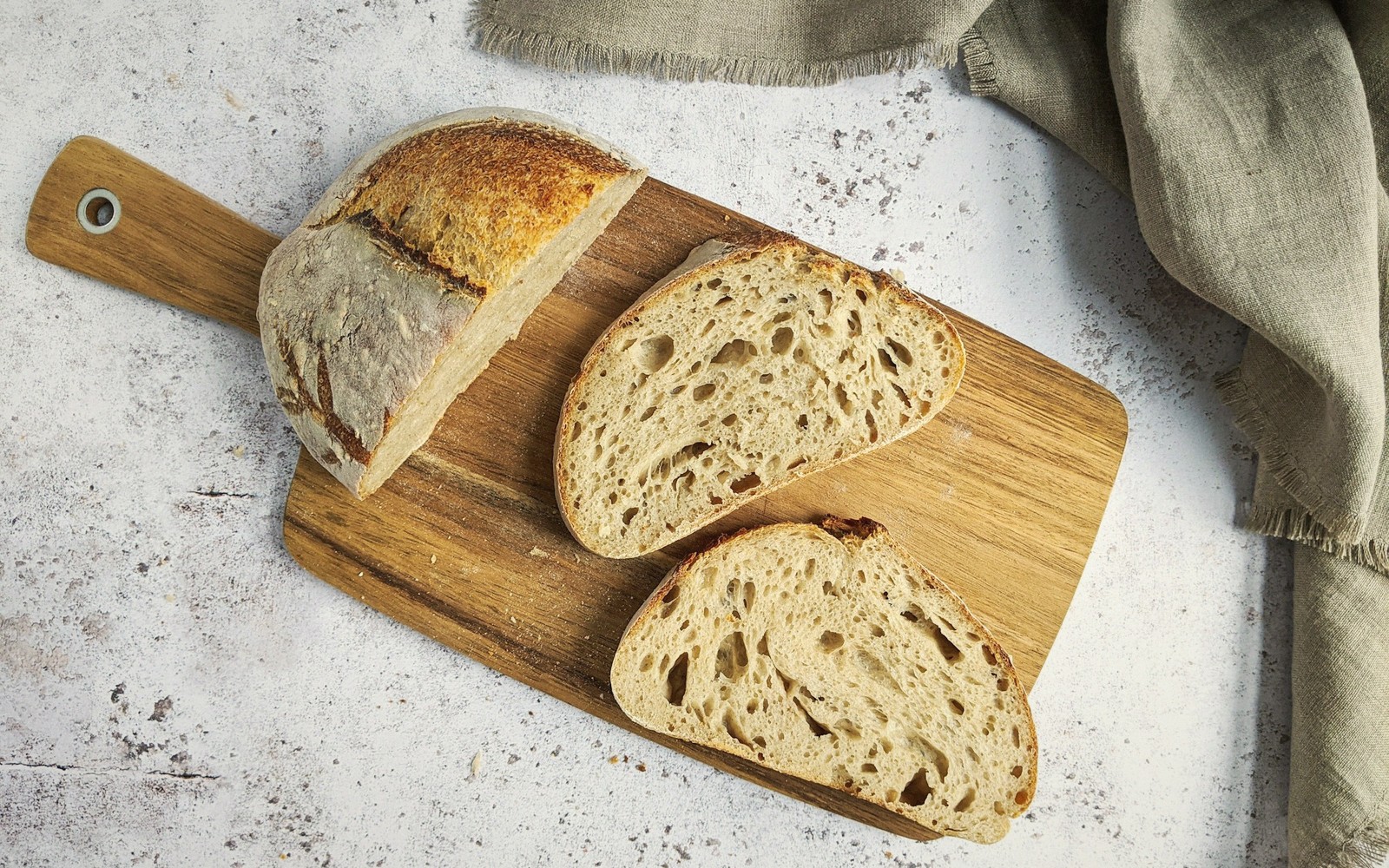
- Cool on a rack for at least 30 minutes before cutting. Cutting too soon collapses the crumb.
A few things that genuinely matter: use strong bread flour, not plain. Measure your yeast by weight if you can — a little goes a long way, and too much makes a yeasty-tasting loaf that also stales faster. And trust the colour: pull it when it looks almost overdone, because underbaked bread is dense bread.
- Thursday, 9 pmStir flour, yeast, salt and water into a shaggy dough. Five minutes, no kneading.
- Friday, late morning — 12–18 hrs onBubbly and doubled. Fold two or three times, shape loosely.
- Plus 1–2 hrsDough rests while the lidded pot heats at 240 °C.
- 30 minutesLid on — steam does the work of a bakery oven.
- 15 minutes moreLid off, crust deepens to almost-overdone. Trust the colour.
- Plus 30 minutesCool on a rack. Cutting early collapses the crumb.
What to Do With the Ends
No loaf lasts perfectly. The heel and the final stiff slices are a test of whether you think of bread as a perishable or a resource. We think of it as a resource.
Toast, but better. A thick slice of day-three bread, toasted hard and rubbed with a cut garlic clove, is the base for almost everything — good olive oil, slow-roasted tomatoes, a smear of ricotta. The dryness is the point; fresh bread would go soggy.
Breadcrumbs. Tear or blitz stale bread into rough crumbs, toast them in a dry pan with a little oil and a pinch of salt until golden, and suddenly you have the best thing to finish pasta, roasted vegetables, or a bowl of soup. They keep in a jar for a week.
Ribollita base. Thick slices of stale bread dropped into a pot of bean-and-vegetable soup and simmered until it thickens — ribollita, essentially — is one of the more honest things you can cook. The bread disappears into the broth and becomes the body of the dish.
Freezer slices. Slice whatever you won't use in two days, wrap in a clean cloth inside a bag, and freeze. Individual slices toast from frozen in about four minutes.
One loaf, made on Thursday evening, carried through to Tuesday. That's the whole idea — not a heroic baking practice, just a quiet, useful rhythm.